

Creatine Science for Strength and Performance in Dublin.
Creatine has moved beyond bodybuilding conversations. If you train around a demanding career, want to get stronger, or hope to preserve physical capability as you get older, you may have wondered whether it deserves a place in your routine.
The answer depends on your goal. Creatine monohydrate is one of the best studied supplements for repeated, high intensity exercise. It can help you do more quality work in training and support gains in strength and lean mass when paired with resistance exercise. It does not replace a good programme, enough food or proper recovery.
At CMB Gym in Dublin, we look at supplements through that wider lens. This guide explains the ATP and ADP mechanism, who may benefit, how to use creatine, and what the latest studies say about DHT and cognitive performance during sleep loss.
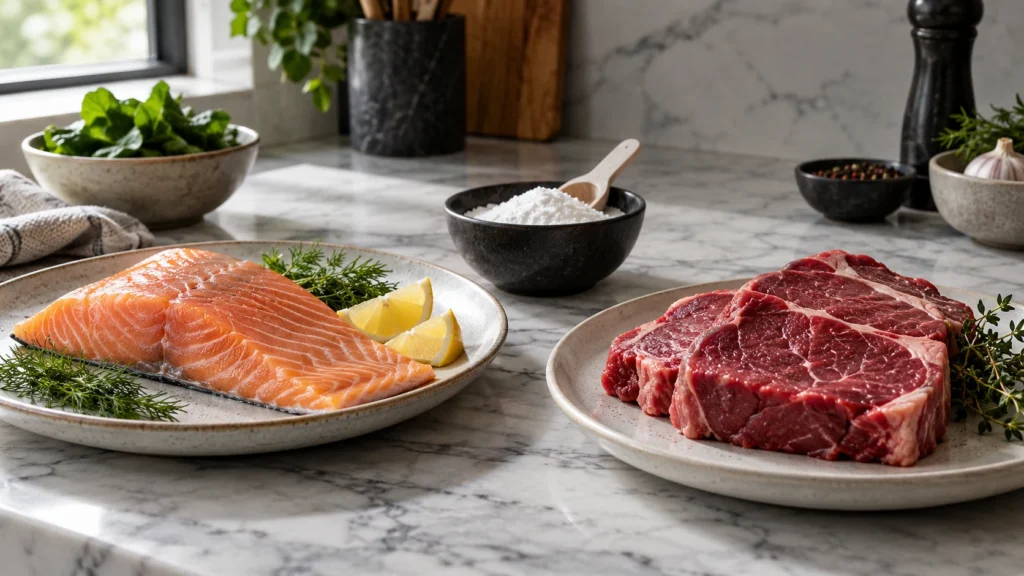
Creatine is a compound your body makes from amino acids. You also obtain some from animal foods, particularly meat and fish. Most of the creatine in your body is stored in skeletal muscle, with smaller amounts in the brain and other tissues.
Inside muscle, some creatine becomes phosphocreatine. During a short, hard effort, your muscles use ATP, their immediate energy source. Phosphocreatine helps rebuild ATP quickly, which matters when you lift a heavy set, sprint, or repeat another demanding effort before you have fully recovered.
Supplementing with creatine can increase muscle creatine stores. That is the basis for its performance effect. It is not a stimulant, and you should not expect the immediate sensation you might get from caffeine.
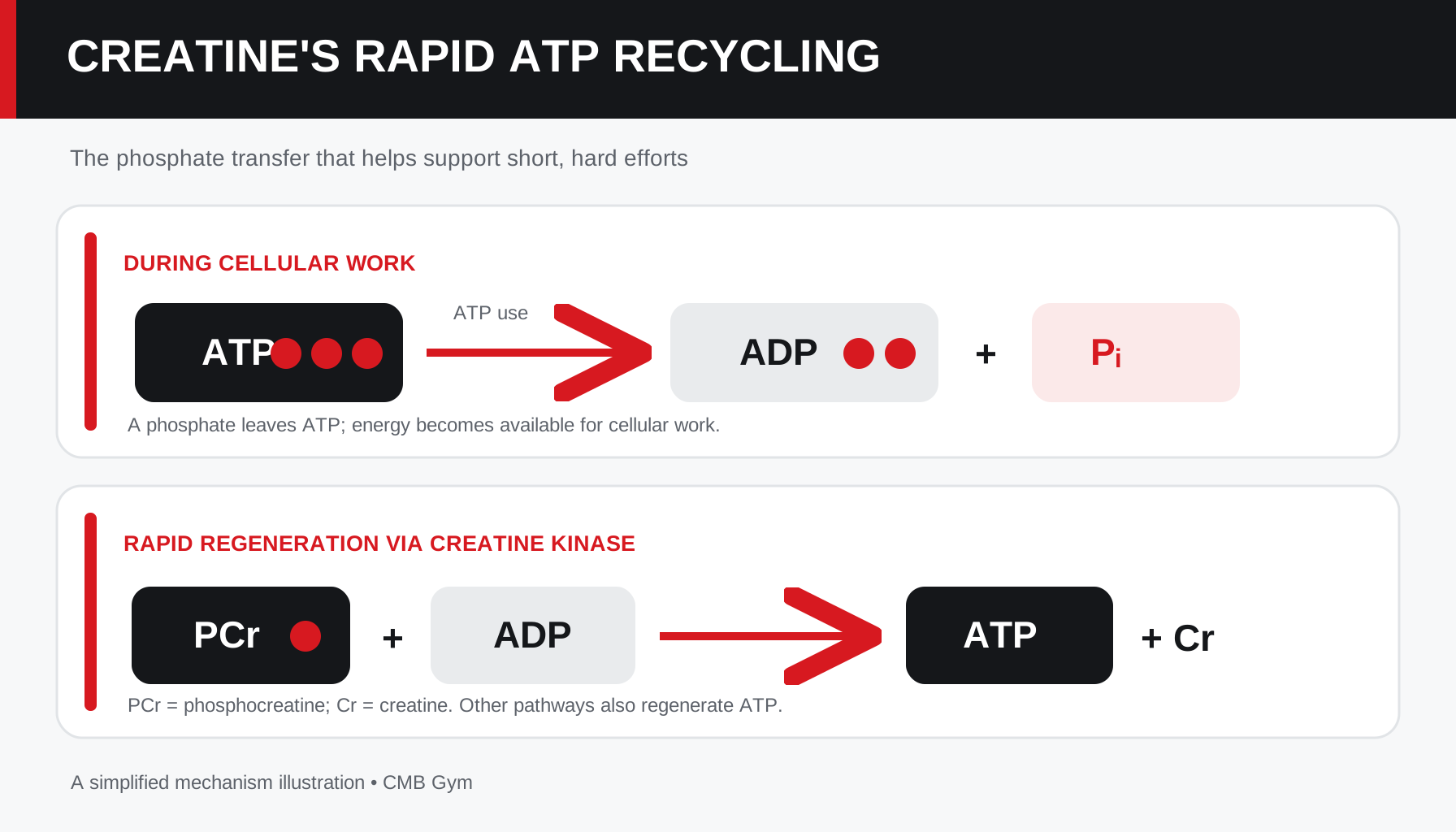
ATP stands for adenosine triphosphate. Its three phosphate groups are central to its role as an immediately available energy carrier. When the terminal phosphate is removed, ATP becomes ADP, or adenosine diphosphate, and energy is released for cellular work. A muscle cannot rely on a large stockpile of ATP; it must keep regenerating it as exercise continues.
Phosphocreatine offers one fast route back. The enzyme creatine kinase transfers a phosphate group from phosphocreatine to ADP, rebuilding ATP. In simple terms: ATP becomes ADP during effort; phosphocreatine helps turn ADP back into ATP. That rapid exchange is especially relevant at the start of a sprint or lift and between repeated hard efforts. Other energy systems also make ATP, particularly as activity continues; creatine does not replace them.
This explains the gap between a plausible mechanism and a useful outcome. Raising muscle creatine stores can increase the phosphocreatine available for rapid ATP regeneration. Whether that translates into a meaningful improvement depends on the demands of the exercise and the individual’s response.
The strongest evidence concerns repeated bursts of intense exercise and resistance training. Creatine can help some people complete more work across hard sets and support improvements in strength and power. Over time, that extra training capacity may contribute to greater lean mass when the programme is progressive and nutrition supports the goal.

The effect is individual. A person’s starting creatine stores, diet, training status and programme can influence the response. More is not automatically better, and the supplement cannot compensate for a poorly designed plan.
For a busy professional, the practical question is not whether creatine is fashionable. It is whether you are training consistently enough to make use of the extra capacity. Two or three well structured strength sessions each week, progressed over time, will usually matter more than the brand of powder in your cupboard.
An early increase in body weight can reflect a change in water held within muscle, especially if you use a loading phase. That is not the same as gaining body fat or immediately building new muscle tissue.
Longer term muscle gains require repeated training, adequate energy and protein, and recovery. Creatine can support that process; it does not create it by itself. A systematic review of trials using direct measures of muscle size estimated a very small additional effect with creatine and resistance training, but the estimate was uncertain.[1]
Creatine is often associated with competitive sport, but strength and physical function matter well beyond a sporting career. Research in older adults suggests creatine may add to gains in strength and lean mass when combined with resistance training.[2] The exercise programme is still the foundation, and health circumstances should guide the decision.
People who eat little meat or fish may consume less preformed creatine. That makes supplementation a reasonable option to consider, but a plant based diet does not guarantee a larger response or a particular cognitive benefit. The same principles apply: identify the goal, train appropriately, and assess your own progress.
The brain also uses ATP and contains a creatine and phosphocreatine system. This gives researchers a reason to study creatine during tasks that place unusual demands on brain energy. It does not mean that taking a standard daily serving will automatically make a rested person think faster. Reviews of cognitive trials have found mixed results across different people, doses and tests.[3][4]

In a 2024 crossover experiment, 15 people stayed awake overnight and received a single 0.35 g per kg of body weight dose of creatine monohydrate or placebo. For a 70 kg person, that research dose would be about 24.5 g at once. Brain spectroscopy showed changes in creatine related high energy phosphate measures, and some cognitive tasks deteriorated less under creatine than placebo during the hours tested.[9]
A 2026 crossover study tested a lower, but still large, 0.2 g per kg single dose in 29 healthy participants during about 21 hours without sleep. For a 70 kg person, that would be 14 g. The researchers reported less deterioration in selected logic, numerical, language processing and vigilance measures, with a smaller effect than in the earlier high dose study.[10]
These experiments are interesting because the benefit appeared in an unusual state of sleep loss, when energy demands and brain metabolism may differ from normal conditions. The studies were small and measured short term laboratory performance. They do not establish a routine “mega dose” protocol, long term safety at those doses, or a reliable cognitive boost for well rested adults. Sleep remains the priority; creatine is not a substitute for it.
Similarly, creatine helps with a specific cellular energy process. It should not be sold as a general cure for tiredness. If fatigue is persistent, it is worth looking at sleep, food intake, training load and medical factors rather than masking the problem with a supplement.
For most people, creatine monohydrate is the sensible starting point. It is the form used in most of the research, is straightforward to dose and is usually good value. A micronised powder is still monohydrate; the smaller particles may make it easier to mix.
Creatine hydrochloride, buffered creatine and other variations are often marketed as more advanced or more absorbable. Greater solubility in a drink does not prove a better training outcome or establish that a smaller dose works as well. In a direct comparison, a buffered product did not outperform monohydrate for muscle creatine, body composition or training adaptations.[5]
Choose a product with the form and amount per serving clearly stated. If you compete in a tested sport, check whether the exact product and relevant batch are covered by a current third party testing programme. A label claim on its own is not the same as verified certification.
A practical approach for many adults is 3 to 5 g of creatine monohydrate each day. Taken consistently, this raises muscle creatine stores over several weeks. The response and timing vary between individuals.[6]
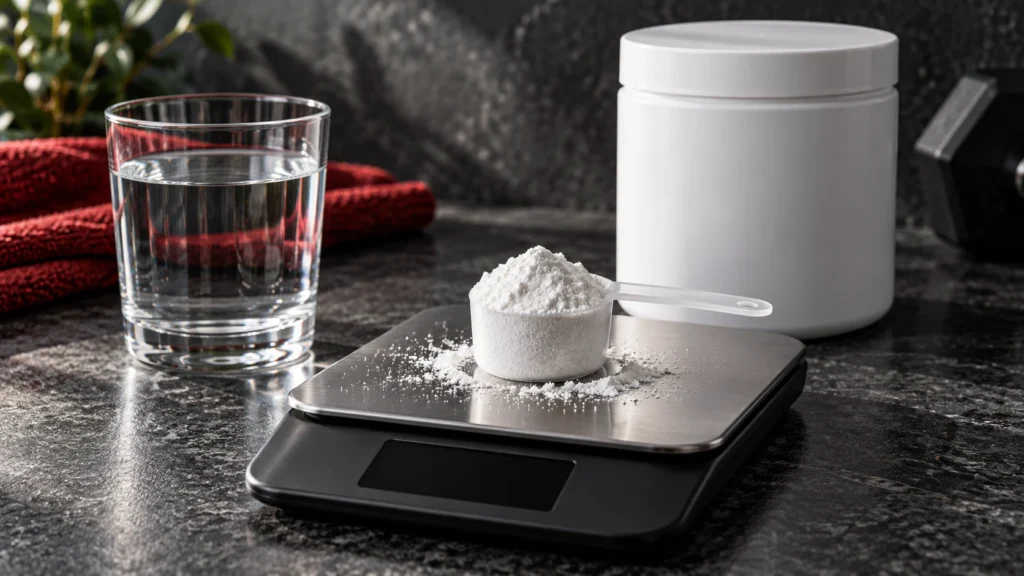
There is an optional faster route: approximately 20 g per day for 5 to 7 days, divided into four servings of about 5 g, followed by a maintenance dose of 3 to 5 g daily. Loading can raise stores sooner, but it is not essential. Larger servings may be uncomfortable for some people, so the steady daily approach often fits real life better.
You do not need to cycle creatine as part of the usual performance protocol. Nor should you double the serving after a missed day. Return to your normal routine and focus on consistency.
There is no well established ideal hour for everyone. Research on taking creatine immediately before or after exercise does not support a confident promise that one time produces better results.[7]
Take it with a meal, after training, or at another time you can reliably remember. The routine matters more than a perfect minute on the clock. If your stomach is sensitive, taking it with food, dividing the dose or skipping loading may help.
Creatine monohydrate has been studied extensively in healthy adults. Digestive discomfort, such as bloating or loose stools, can occur, particularly with large single servings or loading. Start with a measured dose and pay attention to your response.
Creatine can also increase blood creatinine, a marker used in kidney assessments, without necessarily reducing kidney filtration. A recent systematic review and meta analysis did not find a significant reduction in glomerular filtration rate in the studied conditions.[8] That finding should not be applied automatically to someone with kidney disease or an unexplained abnormal result.
If you have a kidney condition, take medicines that affect kidney function or fluid balance, or are dealing with a significant health concern, discuss supplementation with your clinician. Tell them you take creatine when blood tests are interpreted.
DHT, or dihydrotestosterone, is an androgen formed from testosterone by the enzyme 5 alpha reductase. It plays a role in androgen related hair loss in genetically susceptible people. That is why a possible creatine and DHT link deserves a direct look rather than a casual reassurance.
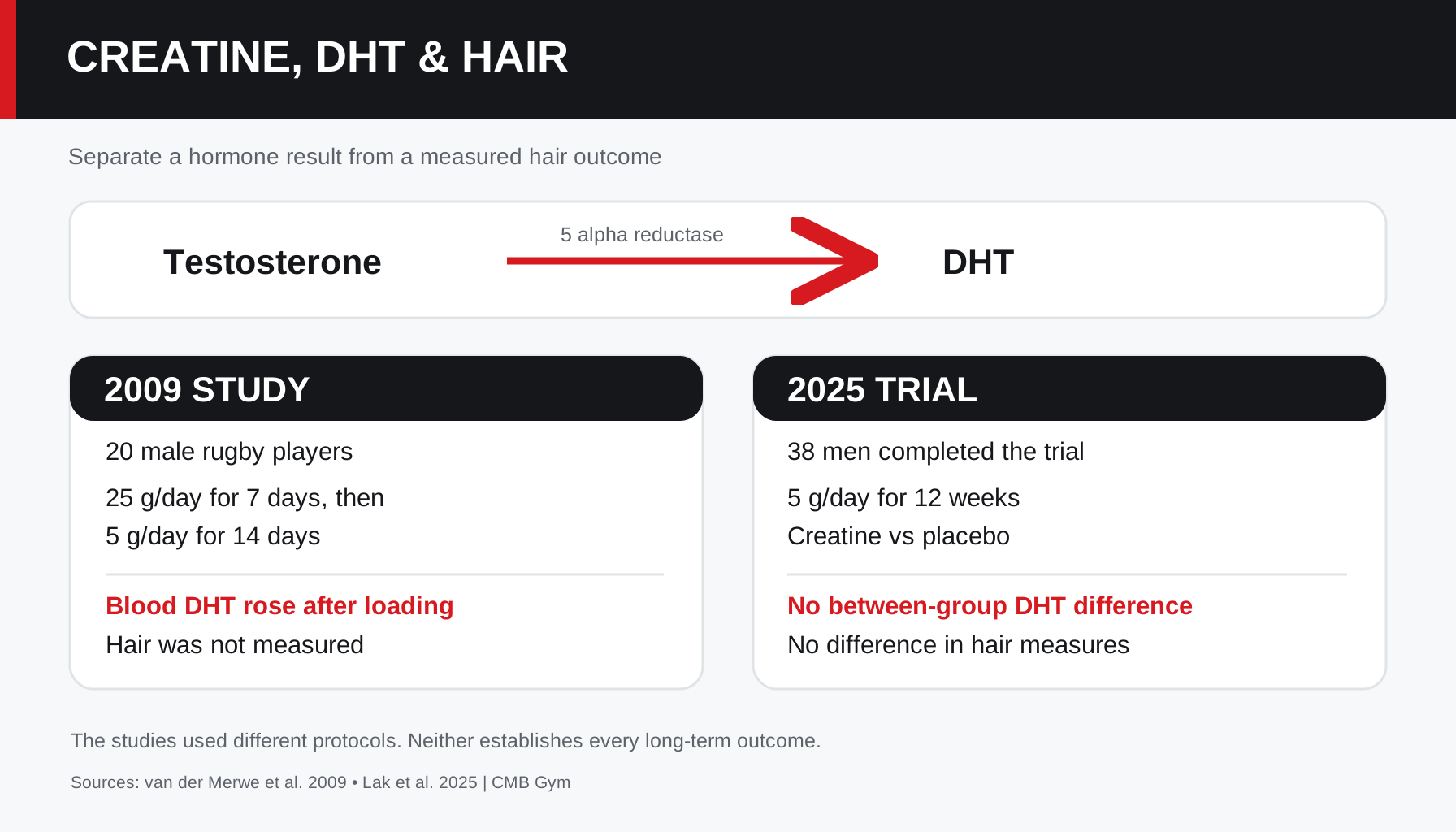
A 2009 crossover study followed 20 male rugby players. After seven days of 25 g daily creatine loading, their blood DHT was 56% above baseline; it remained 40% above baseline after 14 days at 5 g daily. Testosterone did not change significantly. The study measured circulating hormones, not hair loss, and its small, short protocol cannot show what happens with ordinary long term use.[11]
In a later 12 week randomised trial, 38 resistance trained men completed a comparison of 5 g daily creatine with placebo. Researchers measured blood DHT and several hair growth measures. They found no significant difference between groups in DHT, the DHT to testosterone ratio or hair outcomes.[12] That is reassuring for the dose and population studied, though it cannot rule out every possible effect over years, with different doses or in other groups.
The fair conclusion is that creatine has not been shown to cause hair loss. One older DHT signal is not proof of baldness, and the direct hair study did not replicate a DHT difference. If hair loss is a personal concern, consider family history and speak with a qualified clinician about its many possible causes.
Creatine works best as a small part of a clear plan. First decide what you are trying to improve: stronger lifts, more repeatable effort in training, or preserving strength as life gets busier. Then match the supplement to a programme you can sustain.
At CMB Gym, our approach to personal training in Dublin starts with progressive strength work and an honest review of the factors around it. We look at nutrition, sleep, recovery and the demands of a client’s schedule. A supplement may help, but it is only one decision within that larger picture.
If you are returning to training after a long break, the first priority may be rebuilding a routine and movement capacity. If you already train consistently, creatine may offer a modest advantage in the work you can repeat and progress. Review performance over weeks, rather than judging the value of a single serving or a change on the scale.
Yes, if you choose to use it, a daily routine is the simplest way to maintain muscle creatine stores. Rest days are part of that routine.
Creatine does not directly cause body fat gain. The scale may move early because of changes in water within muscle, particularly during loading. Longer term fat change depends on your energy balance and wider habits.
No. Loading raises muscle stores more quickly, while a steady 3 to 5 g daily approach reaches higher stores more gradually. Choose the method you can tolerate and follow.
Yes. Daily use can support your regular training sessions even when you do not exercise every day. The benefit is most relevant when those sessions include repeated hard efforts or progressive resistance work.
The sleep deprivation studies used single doses far above the standard 3 to 5 g daily maintenance amount under controlled research conditions. Their results do not provide a general recommendation to take a large dose after a bad night. Prioritise recovery and seek individual clinical advice if you are considering a dose outside the usual protocol.

The best case for creatine is straightforward: monohydrate is well studied, a daily dose is simple, and it can support high intensity training and strength development when the fundamentals are already in place. Claims about guaranteed focus, a universal energy boost or dramatic transformation go beyond the evidence.
If you want to build strength with a programme that fits your schedule, speak with CMB Gym about personal training in Dublin 2. We will help you turn the science into a practical plan built around your starting point and goals.
1. Burke R et al. The effects of creatine supplementation combined with resistance training on regional measures of muscle hypertrophy. Nutrients. 2023. https://doi.org/10.3390/nu15092116
2. Devries MC, Phillips SM. Creatine supplementation during resistance training in older adults: a meta analysis. Medicine and Science in Sports and Exercise. 2014. https://doi.org/10.1249/MSS.0000000000000220
3. Avgerinos KI et al. Effects of creatine supplementation on cognitive function of healthy individuals. Experimental Gerontology. 2018. https://doi.org/10.1016/j.exger.2018.04.013
4. McMorris T et al. Creatine supplementation research fails to support the theoretical basis for an effect on cognition. Behavioural Brain Research. 2024. https://doi.org/10.1016/j.bbr.2024.114982
5. Jagim AR et al. A buffered form of creatine does not promote greater changes than creatine monohydrate. Journal of the International Society of Sports Nutrition. 2012. https://doi.org/10.1186/1550-2783-9-43
6. Hultman E et al. Muscle creatine loading in men. Journal of Applied Physiology. 1996. https://doi.org/10.1152/jappl.1996.81.1.232
7. Ribeiro F et al. Timing of creatine supplementation around exercise. Nutrients. 2021. https://doi.org/10.3390/nu13082844
8. Naeini EK et al. Effect of creatine supplementation on kidney function. BMC Nephrology. 2025. https://doi.org/10.1186/s12882-025-04558-6
9. Gordji-Nejad A et al. Single dose creatine improves cognitive performance and induces changes in cerebral high energy phosphates during sleep deprivation. Scientific Reports. 2024. https://doi.org/10.1038/s41598-024-54249-9
10. Gordji-Nejad A et al. Single dose creatine reduces sleep deprivation induced deterioration in cognitive performance. Nutrients. 2026. https://doi.org/10.3390/nu18081192
11. van der Merwe J, Brooks NE, Myburgh KH. Three weeks of creatine monohydrate supplementation affects dihydrotestosterone to testosterone ratio in college aged rugby players. Clinical Journal of Sport Medicine. 2009. https://doi.org/10.1097/JSM.0b013e3181b8b52f
12. Lak M et al. Does creatine cause hair loss? A 12 week randomized controlled trial. Journal of the International Society of Sports Nutrition. 2025. https://doi.org/10.1080/15502783.2025.2495229
Connect one-on-one to discuss your unique fitness needs and goals.
Connect one-on-one to discuss your unique fitness needs and goals.
€60 consultation charge.
24 hours cancellation notice required.






Book your consultation with our expert team, and we’ll design a results-focused training program tailored specifically to your goals.
Mon - Fri : 7:00am to 9.00pm
Sat : 9.00am to 1.00pm
Sun & Bank Holidays : Closed